It's His Job
Roy Keane never celebrates the ordinary, out of standards. Engineers do the same, out of self-doubt. The same three words, and the difference between them takes a career to see.
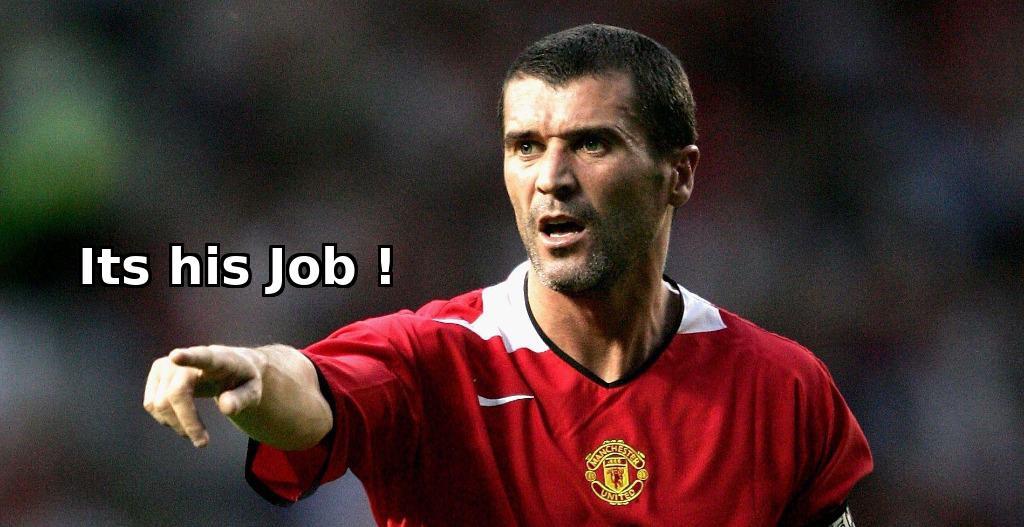
Roy Keane has never been comfortable with applause. For the better part of a decade he captained Manchester United with a ferocity that defined an era, won nearly everything the game offers, and has spent the years since on television refusing to enjoy any of it on anyone’s behalf. A defender heads a ball off the line, a goalkeeper makes the save he was signed to make, the studio reaches for the word heroic, and Keane just stares. It’s his job. For reasons I have stopped trying to justify, few footballers have ever meant more to me.
The thing most people miss about that stare is that it is not cruelty. Keane is not saying the defender is bad. He is saying the bar was always there, and clearing it is not an achievement, it is the arrangement. You are paid to defend. You defended. Nobody earns a medal for turning up to the thing they agreed to do. Praise, in Keane’s world, is for what happens above the line, and most of what gets praised sits comfortably below it.
It is a hard way to watch football. It is also, if you have ever done serious work, uncomfortably familiar.
Because engineers say the same three words and mean something close to the opposite. Someone calls the work impressive, and the engineer who has been at it fifteen years does not hear a compliment. They hear a small error in the other person’s judgement. It’s just my job. Not standards, not Keane’s refusal to inflate the ordinary. Something quieter and more corrosive, an inability to see the work as anything at all.
It is a strange thing, to admire one man for refusing to inflate the ordinary and then to catch yourself deflating your own. The two sound like the same instinct. They take years to tell apart.
Watch the shape of a technical career and the trap builds itself. You start knowing nothing, everything is hard, and you can feel every new thing you learn because the learning hurts. Then you get good. The hard things go quiet. The knowledge that took a decade to earn stops feeling like knowledge and starts feeling like air, the medium you move through, weightless, obvious, nothing. The better you get, the more of your real expertise dissolves into that fog of obviously. By the time you could teach it, you can no longer see it.
Last month I caught myself wanting to cut a story about a calibration line from an article, because it felt too obvious to be worth telling. It is probably the most useful paragraph in the piece.
The gap has a name, though naming it does not cure it. Once you have truly learned something, you lose the ability to remember not knowing it. Obviousness is not a property of the fact. It is a feeling, and it is the one feeling your own mind cannot be trusted about, because the more you know, the more it quietly files under everyone knows this. Nobody knows this. You have just lost the ability to feel that you do.
Which is where Keane turns out to be half right, and the engineer half wrong, and it takes far too long to work out which half is which.
Keane is right about the standard. You should not need applause for doing the job. The engineer who fishes for it, who needs the room to be impressed, is usually a worse engineer for the wanting, and a worse colleague besides. The refusal to celebrate the baseline is not the flaw. It is a kind of dignity.
The mistake was never the modesty. It was the measurement. Keane and the engineer are both standing at a line, refusing to make a fuss about clearing it, and they are standing at completely different lines. Keane’s baseline is the summit of the professional game, where clearing it really is just the job. The engineer’s baseline is fifteen years of accumulated, invisible, dearly bought judgement. Treating that as ordinary is not humility. It is an error of measurement. Somewhere along the way you assumed your own floor was everyone’s floor, and it is nowhere close.
So the honest position is a divided one. Keep the standard. Do not go looking for the room to clap. And separately, stop mistaking the height of your own floor for the height of everyone else’s. Humility about the effort, which costs nothing and keeps you worth working with. Accuracy about the value, which you owe to the people who could actually use what you know and will never get it while you keep calling it nothing.
Keane would still say it’s your job. He would be right. The job was never the part worth arguing about. Whether you can still see it for what it is, after all the years of it going quiet, is the part that takes a career.
© 2026 Varun Vummaneni. Originally published at wellcalibrated.co. All rights reserved.