Robotaxi L4 vs. Consumer L2+: Two Industries Pretending to Be One
The public conversation about autonomous driving treats robotaxis and consumer driver-assistance as points on one ladder, as if a hands-free highway system is simply a robotaxi that hasn't finished climbing. I've worked…
Contents
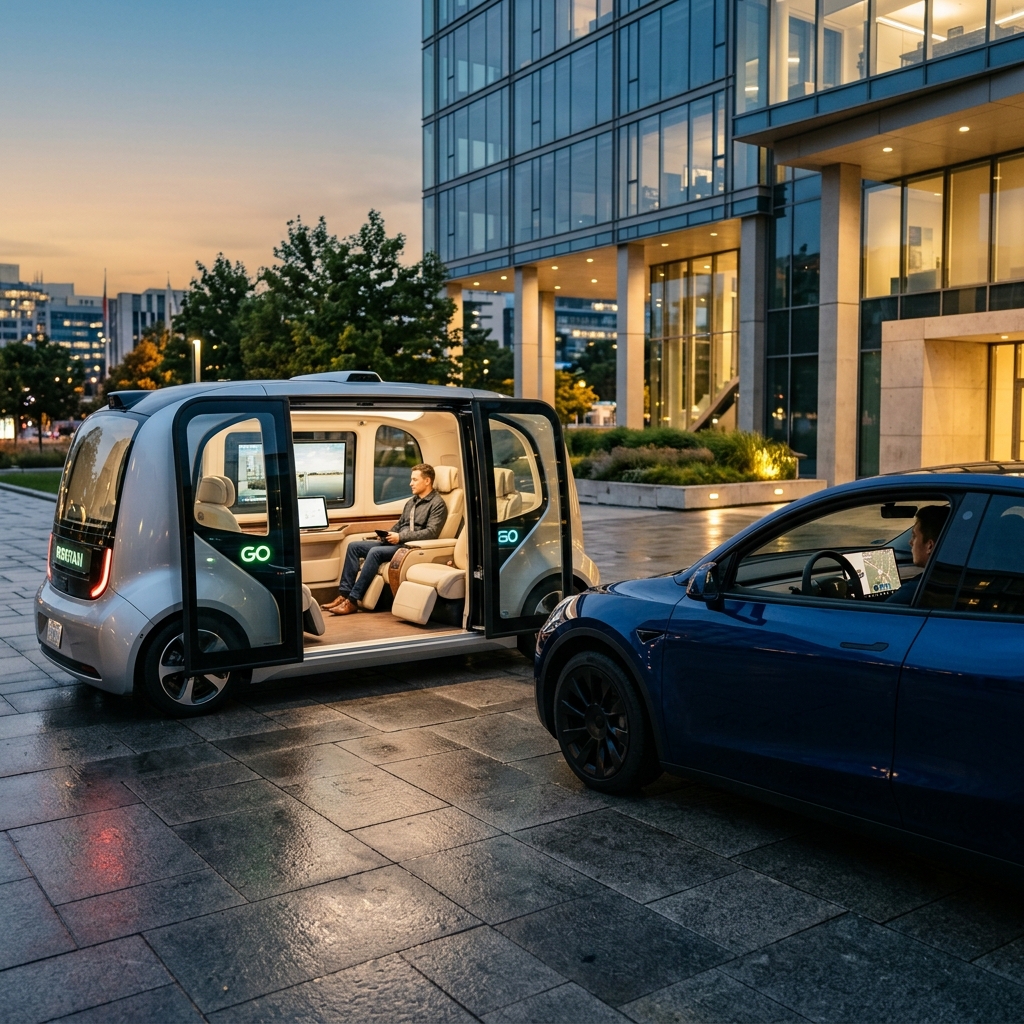
The public conversation about autonomous driving treats robotaxis and consumer driver-assistance as points on one ladder, as if a hands-free highway system is simply a robotaxi that hasn’t finished climbing. I’ve worked both rungs: radar systems on an L4 robotaxi program, and radar and other perception sensors on consumer ADAS platforms. After sitting in both chairs, my honest read is that these are not two maturity stages of one product. They are two different engineering disciplines with different economics, different sensor philosophies, different failure-handling contracts, and different definitions of “done”, and conflating them produces bad strategy, bad hiring, and bad public expectations.
The SAE levels are partly to blame, not because the taxonomy is wrong, but because of how it gets read. So let’s start there.
What J3016 actually says, and the ladder it doesn’t build
SAE J3016 is a taxonomy of who does what, not a technology maturity scale. The current edition (J3016_202104) draws the load-bearing line at responsibility for the dynamic driving task and its fallback. At Level 2, the system sustains lateral and longitudinal control, but the human driver supervises continuously and must notice and react to the events the system can’t, the driver is the fallback (Koopman’s J3016 user guide is the best public walkthrough of this). At Level 4, the system performs the entire driving task and the entire fallback within a defined operational design domain; if it exits the ODD or something goes wrong, the system itself must achieve a minimal risk condition (in the 2021 edition, a stable, stopped state) with no expectation that a human takes over.
Read carefully, that is not a ladder. It’s a fork. At L2 you are engineering a system whose safety concept has a trained-but-fallible human inside it. At L4 you are engineering a system whose safety concept explicitly excludes one. Those are different problems, and almost nothing about solving the first is a partial credit toward solving the second. The numbering implies progression; the definitions describe a discontinuity.
Level 3 (where the system drives but a human must be receivable as fallback) sits in the gap, and the fact that the most prominent certified L3 system in the U.S. launched restricted to specific freeways at speeds up to 40 mph in heavy traffic, certified first in Nevada and then California (Mercedes-Benz), tells you how narrow the bridge between the two disciplines really is. The narrowness has a cause worth naming. L3 moves the driving task to the machine but keeps a human as a delayed fallback, which means the safety concept depends on re-engaging someone who has been permitted to stop paying attention. Europe’s ALKS regulation gives that person at least 10 seconds to respond to a transition demand before the system brings the vehicle to a stop itself (UNECE R157). Ten seconds is a long time in traffic and a short time to rebuild situational awareness, and the way to make that argument defensible is to shrink the envelope until very little can go wrong inside it. That narrowness isn’t a Mercedes problem. It’s what happens when L4 liability is fitted into a consumer format.
Sensor architecture: redundancy budgets vs. BOM budgets
Here is where the fork shows up first, because I’ve written radar requirements on both sides of it.
On the robotaxi side, that meant imaging radar integration across perception, systems, manufacturing, and quality teams: mounting locations, electrical interfaces, and field-of-view coverage sufficient for 360° detection in autonomous operation. Notice what the requirement is: 360° coverage from this modality, on top of cameras, on top of lidar. Overlapping fields of view from independent physical modalities aren’t gold-plating; they’re the mechanism by which the system earns the right to have no human fallback. When there is no driver to catch the case your camera can’t see, the sensor suite has to catch it, and the safety case has to argue (with evidence) that it will. Every sensor you add buys detection redundancy, cross-modal plausibility checking, and coverage of another slice of the failure-mode map.
On the consumer side, owning radar for a next-generation ADAS platform meant much of the same work ran in the opposite direction: BOM and cost optimization with Tier-1 suppliers, driving down module size, power consumption, and thermal footprint so the sensor could scale across vehicle architectures. On another radar platform, redesigning the end-of-line calibration process and the manufacturing line procedure around it produced approximately six figures in savings. That is what winning looks like in consumer ADAS: the same function, cheaper, smaller, cooler, faster to build.
Both of these are legitimate, difficult engineering. But they optimize in opposite directions, and the reason is arithmetic, not philosophy. A robotaxi amortizes its sensor suite over hundreds of thousands of revenue miles; a few thousand dollars of extra sensing is a rounding error against the cost of a safety incident or a stranded vehicle. A consumer platform multiplies every dollar of BOM by hundreds of thousands of units against a take rate and a margin target; a $40 delta per sensor is a career-defining fight. An engineer who has only lived in one of these regimes will make confidently wrong decisions in the other: a robotaxi-shaped sensor proposal does not survive an OEM cost review, and a consumer-shaped suite cannot carry the redundancy argument an L4 safety case needs.
There is a fair objection here, and it gets louder every model year: consumer EVs now ship dense suites of their own, lidar on the roof, more radars, more compute. If the hardware converges, doesn’t the gap close? In my experience it doesn’t, because the expensive part was never the sensors. A consumer suite, however dense, still runs on a fail-safe contract. When something degrades, the system announces it and hands back to the person already sitting there. Take that person out and the vehicle itself has to keep operating through the failure, which pushes redundancy down out of the sensor set and into the platform: Waymo describes a secondary braking system, a redundant steering motor with independent controllers and separate power supplies, independent power for each critical system, and a second computer running in the background (Waymo). None of that appears in a sensor comparison, and on a car whose driver’s seat is occupied, none of it is recoverable. Sensor count is the visible half of the argument. What sits underneath is where the two disciplines actually part company.
Program-level implication: when you evaluate a sensor architecture, ask which arithmetic it was designed under before you ask whether it’s “good.” A suite can be excellent under one and indefensible under the other.
The ODD is enforced by different mechanisms
J3016 gives both disciplines the same vocabulary (every feature has an operational design domain) but the enforcement of the ODD is where they diverge completely.
A robotaxi ODD is enforced by engineering and operations: geofences, HD-map coverage, weather policies, remote-assistance capacity, depot placement. The system will not operate outside it, structurally. That’s why robotaxi expansion happens city by city, corridor by corridor: Waymo went from roughly 250,000 paid weekly rides in April 2025 to about 500,000 by March 2026 by methodically adding metros, not by flipping a software switch (CNBC, TechCrunch). The ODD is a wall the engineering built.
A consumer L2+ ODD is, in practice, enforced by the driver, the system may warn, may disengage, but the human is the mechanism that keeps the feature inside the envelope, and humans are unreliable enforcement. This is precisely why driver monitoring became the load-bearing component of consumer L2+: the DMS is not an accessory feature, it is the safety mechanism that makes the entire driver-in-the-loop assumption defensible. Hands-free highway driving didn’t become shippable when lane-centering got good; it became shippable when eye-tracking got good enough to verify the fallback was actually present and attentive. The perception problem that gates consumer L2+ points inward at the human. The perception problem that gates a robotaxi points outward at the world. Same J3016 vocabulary; almost disjoint engineering.
Program-level implication: in a consumer L2+ program, DMS performance and driver-state strategy deserve the same architectural attention as forward perception, because your safety concept collapses without them. In a robotaxi program, that budget goes to remote assistance and minimal-risk-condition behavior instead, the machinery of failing gracefully without anyone in the seat.
Qualification and production: two definitions of “done”
The process side diverges just as sharply, and this is the part public discourse rarely touches because it isn’t visible from the demo.
Consumer ADAS lives inside the automotive production machine. Run environmental qualification on either side and the physics is the same: temperature cycling from −40 °C to +85 °C, vibration profiles, humidity, EMC/EMI. What differs is everything around it. A consumer sensor must survive a 15-year vehicle life with no scheduled maintenance, get built and calibrated on a manufacturing line at takt time, tolerate whatever mounting variation body-in-white delivers, and be serviceable at a dealership by a technician who has never heard of extrinsic calibration. Design freezes are real, model years are real, and a change after start of production is an event with a committee attached.
A robotaxi fleet is owned, maintained, and re-calibrated by the operator. Vehicles return to a depot every day. Sensors can be cleaned, checked, re-aligned, swapped; software can iterate on a cadence no OEM change-control process would recognize; a hardware revision rolls out across thousands of vehicles, not millions. In radar acceptance testing and qualification for a robotaxi deployment, the bar was still rigorous automotive practice, but the lifecycle assumptions underneath it were a fleet operator’s, not a car company’s. The contrast in fleet arithmetic makes the point: Waymo’s U.S. fleet crossed roughly 2,500 robotaxis in late 2025 (Road to Autonomy), and the scaling since has stayed deliberate: in May 2026 Waymo said it would reach more than 1,400 square miles across 11 cities over the following weeks (Waymo), and that July it opened rider-only operations in four more metros, employees first (Waymo). Ford alone, meanwhile, had about 1.22 million BlueCruise-equipped vehicles on the road worldwide, logging 264 million hands-free miles in 2025 (Ford). Nearly three orders of magnitude in fleet size is not a detail. It dictates the qualification philosophy, the calibration strategy, the supplier relationship, and the cost target.
The business models don’t transfer, and the market said so
If the two disciplines were really one industry at different maturity levels, competence in one would transfer to the other. The clearest natural experiment we have says otherwise. GM shut down Cruise’s robotaxi business in December 2024, citing the considerable time and resources needed to scale it, and redirected the effort toward driver-assistance on personal vehicles, explicitly building on Super Cruise, then on more than 20 models and logging over 10 million hands-free miles a month (GM). A company that was competitive in both disciplines looked at the economics and concluded they were separate businesses, and kept the one that matched its production machine.
And the convergence case’s flagship ran the experiment from the other side. The strongest counterargument to everything I’ve written is the data-flywheel thesis, now usually argued through end-to-end foundation models: a consumer fleet generates billions of miles, the miles train the stack, and one day the consumer product graduates into a robotaxi. It’s a real argument and I won’t strawman it, fleet data genuinely is a structural advantage for training perception, and I’ve argued elsewhere in this series that sensor choices are training-data choices. But watch what actually happened when the thesis met the road: Tesla’s robotaxi launch in Austin in June 2025 was roughly ten vehicles, invite-only, geofenced to a mapped service area, with a safety monitor aboard (TechCrunch), and it took until December 2025 to begin testing without one (TechCrunch). A year on, the curve is the tell. Tesla reported cumulative paid robotaxi miles past 2.4 million in its Q2 2026 update, but Q2 added roughly 900,000 paid miles, the same as Q1, on an active unsupervised fleet of about 21 vehicles across Austin, Dallas, Tampa, and Orlando (Electrek). Geofences widened; the service did not compound.
None of that is a criticism, it’s the point. The moment the consumer-fleet company crossed into carrying passengers with no driver responsible, it adopted the robotaxi discipline: constrained ODD, supervised rollout, operational enforcement, city-by-city scaling. The flywheel may feed the perception stack, but it did not exempt anyone from the rest of the L4 problem, the fallback architecture, the operations, the safety case for an empty driver’s seat. Supervised miles are also thinner evidence than they look: they mostly record what a person does while the system is behaving, not what happens when it errs and no one is there to intervene. Removing the human isn’t the last 20% of the L2+ roadmap. It’s a different product that happens to share sensors.
There is a harder objection, and it runs the other direction: if these disciplines are so separate, why is the leading U.S. robotaxi operator moving toward consumer cars? Waymo and Toyota announced a preliminary agreement in April 2025 to explore exactly that, pairing Waymo’s autonomous technology with Toyota’s vehicle expertise for next-generation personally owned vehicles, with the scope set to “continue to evolve through ongoing discussions” (Waymo). I take that seriously, and I think the shape of the deal answers it. Waymo did not decide to become a car company. It went looking for one, because what it lacks is precisely the subject of this article: a production machine, a supplier base, a service network, and a 15-year no-maintenance lifecycle. Toyota isn’t contributing sheet metal to that partnership, it’s contributing the discipline Waymo doesn’t practice.
A business reader will call that ordinary horizontal specialization, software supplier meets vehicle integrator, which this industry does constantly. I’ve worked that interface from both sides and I don’t think it maps. When a Tier-1 ships a lane-keeping module, the OEM integrates it, validates it at vehicle level, and carries the product liability, and the interface is narrow enough to write down. An L4 stack isn’t that kind of part. With nobody in the seat, the software and the platform underneath it share a single safety argument that doesn’t decompose cleanly across two companies, and I have yet to meet an OEM eager to carry vehicle-level liability for a driver it didn’t build. If the two were one industry at different maturity levels, the partnership would be redundant. That the most-scaled L4 operator in the U.S. needs a mass-market OEM to reach personal vehicles is, to me, the cleanest available evidence that they are not.
The obvious retort is Tesla, which never had to go looking for a car company because it already is one. But that is the same experiment run in reverse, and it lands in the same place. Tesla began with everything Waymo went to Toyota for: the production machine, the supplier base, the service network, the fleet, the data flywheel. If owning the consumer side were a head start on L4, Tesla is where we would see it. What we see instead is a company that had to build the robotaxi discipline from scratch anyway, and is scaling it city by city on the numbers above. One operator has to go find the discipline it lacks; the other owned both from the beginning and still had to build the second one separately. Neither direction transfers for free.
What I’d tell each reader
For engineers: decide which discipline you’re practicing, because the instincts don’t transfer as cleanly as the job titles suggest. Robotaxi work will teach you redundancy architecture, fallback behavior, and safety-case construction at a depth consumer programs rarely demand. Consumer work will teach you cost, qualification, calibration-at-volume, and supplier reality at a depth robotaxi programs rarely demand. The rare profile is fluency in both, precisely because so few decision-makers can translate between them.
For engineering leaders: stop asking “what level are we at?” and start asking “who is our fallback, and what does that commit us to?” That single question determines your sensor budget’s direction of optimization, whether your DMS is a feature or a safety mechanism, whether your ODD is enforced by geofence or by human vigilance, and whether your qualification philosophy belongs to a car company or a fleet operator. J3016 will tell you your level. It will not tell you your business, and the levels ladder, read as a roadmap, has already burned strategies and capital on the assumption that one discipline would mature into the other. It won’t. Plan, staff, and budget for the fork.
© 2026 Varun Vummaneni. Originally published at wellcalibrated.co. All rights reserved.